



Internet speed in Laos is faster than most visitors expect. In Vientiane and Luang Prabang, Unitel’s 4G regularly hits 30-60 Mbps, that should be enough for video calls and remote work. The problem is that hotel Wi-Fi can be unreliable, and rural areas are a different story entirely.
If you’re planning a two-week vacation or a remote work escape in Laos, you should know the real numbers by city, by carrier, and by connection type so you’re not caught offline.
Table of Contents
I. Average Internet speed in Laos
Mobile internet coverage in Laos has improved significantly since 2023, thanks to Unitel’s pilot deployment of 5G in Vientiane. Increased tourism demand has prompted network operators to upgrade their tpwers in key destinations.
Here’s what you can realistically expect across different connection types:
| Connection type | Average download speed |
|---|---|
| Mobile data (tourist areas) | 30-60 Mbps |
| Mobile data (rural / mountain areas) | 1-10 Mbps |
| Hotel & Café Wi-Fi | 5-25 Mbps |
| Co-working space | 50-150 Mbps |
Speed test results on speedtest.net by Ookla consistently show the mobile operators Unitel and ETL outperforming Lao Telecom in downtown Vientiane. But Lao Telecom quietly wins in smaller towns like Thakhek and Savannakhet, where Unitel’s tower density is significantly reduced.
II. Mobile Network coverage in Laos: Unitel, Lao Telecom, ETL & TPlus
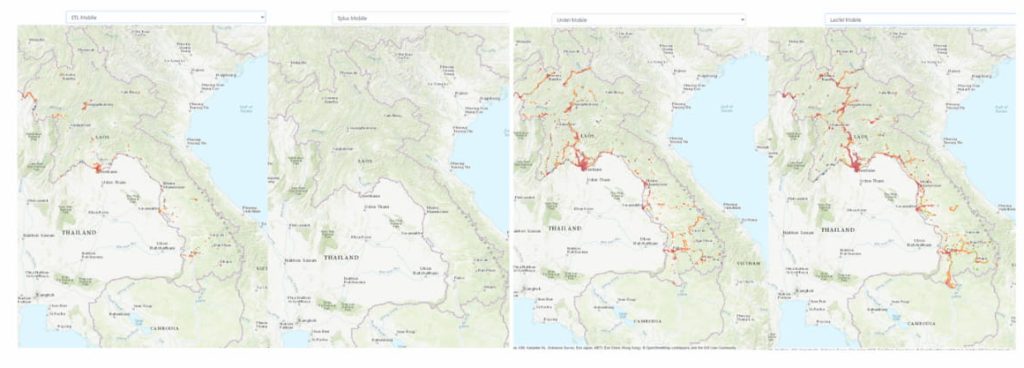
Laos has four main mobile operators, each serving a different set of needs.
Unitel is the top choice for travelers. The brand covers all highways and urban areas with 4G, and is currently developing 5G in Chanthabouly and Sikhottabong districts in Vientiane. Speedtest Awards rank Unitel as the fastest network in Laos with an average download speed of 37.47 Mbps.
ETL is a name many overlook but shouldn’t be. ETL ranks second in actual speeds with 24.13 Mbps download, surpassing even Lao Telecom. It offers nationwide 2G/3G/4G coverage with approximately 2 million subscribers. This is a good option if Unitel sells out its SIM cards at the airport.
Lao Telecom is the oldest network in Laos. Its strength lies in its coverage almost the entire territory, including mountainous northern regions like Phongsali and Luang Namtha. Speeds are lower than Unitel and ETL, but if your journey takes you deep into remote areas, this is the most reliable choice.
TPlus is the best budget option. It offers the cheapest data package on the market, but the slowest speeds among the four. TPlus is suitable for young travelers who use social media frequently, but not ideal for remote work or video calls.
Practical tips: Many travelers have to alternate between two types because no single network provides 100% coverage. If your trip combines urban and mountainous areas, consider Unitel for high-speed connectivity + Lao Telecom for uninterrupted service in remote areas.
III. Internet speed by city: Vientiane, Luang Prabang & Vang Vieng
Speed may vary dramatically depending on where you are. Here’s the breakdown for major tourist attractions in Laos:
Vientiane delivers the fastest internet in the country. Around That Luang and the Patuxai monument Unitel 4G holds steady at 30-50 Mbps. Wattay International Airport has free Wi-Fi in the terminal (5-15 Mbps), but connecting to a Mobile Network upon arrival is more convenient.
Luang Prabang offers solid coverage throughout the UNESCO heritage Old Quarter and along the Mekong riverfront. Expect 15-30 Mbps from major carriers. However Internet on trekking routes and at rural temples will drop to 3G or weaker.
Vang Vieng has good coverage in the town center (15-25 Mbps) to meet the heavy tourist demand. But if you head toward the Blue Lagoons or Nam Song River kayaking routes, you will see signal fades fast.
Pakse & Southern Laos provides adequate 4G coverage in the city itself (10-20 Mbps). The Bolaven Plateau and the 4,000 Islands (Si Phan Don) area have poorer coverage, particularly in the early morning.
IV. Is Hotel & Café Wi-Fi in Laos enough?
Most mid-range guesthouses and restaurants offer free Wi-Fi, with speeds that are reasonably good for basic use. However, the real issue lies in stability, as network congestion during peak hours is common.
At boutique hotels around Luang Prabang’s Old Quarter, Wi-Fi speeds typically peak at 10-20 Mbps. This is sufficient for streaming videos, but be prepared for speeds to slow down after 7 PM when the entire hotel is using the network.
In Vientiane, co-working spaces along Pangkham Road and around the BCEL bank area offer fiber optic connections (50-150 Mbps) specifically for remote workers. This is the best option for video meetings or uploading large amounts of data.
Don't just rely on hotel Wi-Fi in Laos. Laosesim.com offers seamless connectivity from Wattay Airport to Vang Vieng and the slow boat route.
V. How to stay connected in rural & mountain Laos?
The remote areas of Laos, such as the mountain roads between Luang Prabang and Phongsali, trekking routes through Nam Et-Phou Louey National Park, or villages along the Nam Ou River, offer a completely different connectivity experience.
In these areas, data is either slow (1-5 Mbps) or completely unavailable. Here’s how to handle it:
- Download offline maps via Maps.me or Google Maps before leaving any urban areas.
- Download offline media (Netflix, Spotify, podcasts) while your hotel’s Wi-Fi is still available. You’ll be bored on a long journey without them.
- You can choose Lao Telecom if your trip takes you deep into Phongsali or Luang Namtha provinces. Their rural towers is superior to Unitel’s in the far north, and you’ll likely still be connected to the internet.
- Share your travel plans with family before venturing into areas without coverage. Don’t expect to be able to communicate on remote trekking routes.
VII. Frequently Asked Questions
Is Laos internet fast enough to watch Netflix or YouTube?
Yes, on 4G mobile data in Vientiane or Luang Prabang, 30+ Mbps speed can handle HD quality on both platforms without buffering. Netflix HD needs around 5 Mbps; YouTube 1080p needs roughly 8 Mbps.
My phone shows full bars in Vientiane but speed is slow, what’s wrong with it?
Full bars show signal strength, not speed. In crowded areas like Talat Sao Market or near That Luang temple during festivals, network congestion can drop speeds to under 5 Mbps despite strong signal.
You should switch to a less congested band (enable 5G if your device supports it) or use a co-working space fiber connection instead.
Will my eSIM work at the 4,000 Islands in Laos?
Network coverage at Si Phan Don is limited. Places like Don Khong has basic 4G in town, but some area like Don Det and Don Khon rely on 3G at best.
Are websites blocked or censored in Laos?
No. Laos has no internet censorship for tourists or residents. Google, Facebook, YouTube, Instagram, WhatsApp, Telegram, and VPNs all work freely without restrictions.
The government controls local media, but places no blocks on foreign websites or apps. You won’t need a VPN to access any mainstream platform.
Can I share hotspot from my Laos SIM or eSIM to my laptop?
Yes. Both physical SIMs and eSIMs support mobile hotspot sharing. In Vientiane or Luang Prabang, tethered speeds is at around 20-40 Mbps. That’s enough for video calls and cloud tools like Google Drive / Docs / Sheets simultaneously on a laptop.
Is internet in Laos good enough for online gaming?
For competitive play it depends. Nearest game servers are often hosted in Thailand, with latency at 15–20ms from Laos urban areas, acceptable latency for some titles.
Final Words
Connectivity won’t be a problem for you in the cities. Vientiane and Luang Prabang offer mobile speeds comparable to Southeast Asian capitals, and even the small tourist town of Vang Vieng has stable 4G performance in its center. The only limitations are in rural areas and northern Laos.
Internet speed in Laos is constantly improving, so until then, with a little more preparation, such as choosing the right SIM plan, your trip in Laos will clearly be much less frustrating.